
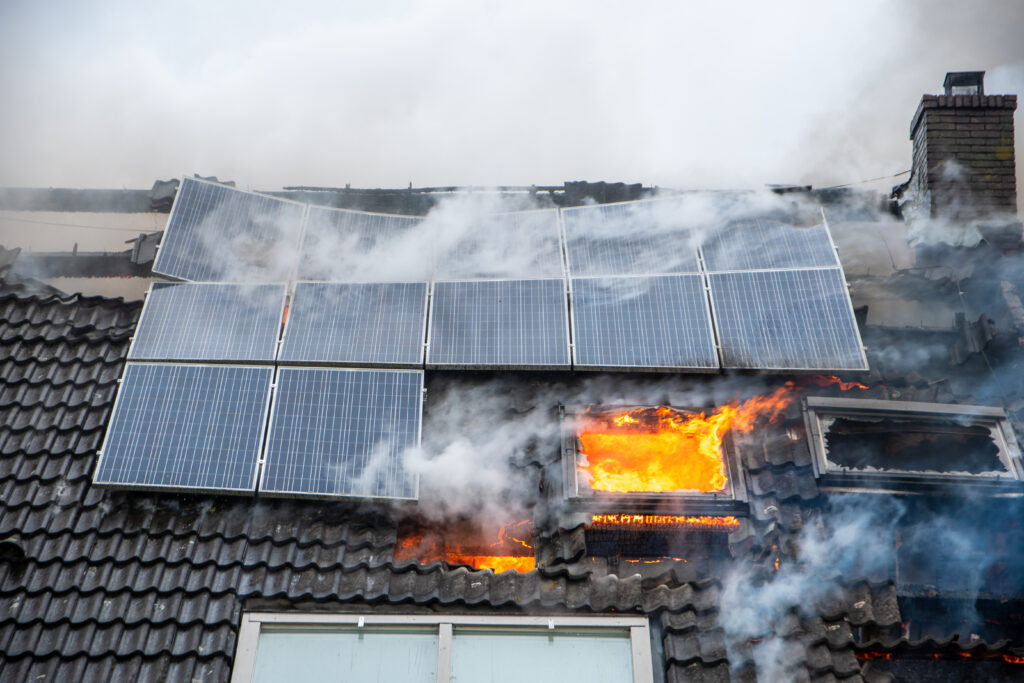
Large-scale fire experiments, commissioned by the Building Safety Regulator (BSR), have identified important fire safety risks associated with photovoltaic (PV) panels installed on pitched roofs.
The testing programme, carried out by the Health and Safety Executive (HSE), found that roofs fitted with PV panels showed increased flame spread compared to those without panels. Researchers concluded that this behaviour was largely influenced by cavities created beneath panels as these spaces allow heat, smoke, and flames to accumulate and travel beneath the panel array, effectively acting as channels that promote flame spread to higher roof structures.
Building-integrated photovoltaic (BIPV) systems demonstrated the greatest fire spread, with concealed cavities also making fires more difficult to extinguish. By comparison, building-applied photovoltaic (BAPV) systems performed more favourably, with mounting rails helping to slow upward flame spread.
Further testing has now been commissioned to better understand the risks and inform future fire safety guidance. In light of these findings, an important question remains as to how identified risks can be managed in the short term. Where immediate remediation is not yet feasible, condensed aerosol suppression systems such as FirePro may provide a practical interim measure to suppress fires at an early stage within concealed cavities and help contain flame spread until permanent solutions are implemented.