
Battery Commander Pro BS1940
Mid-range solution for increased capacity and operational demands.
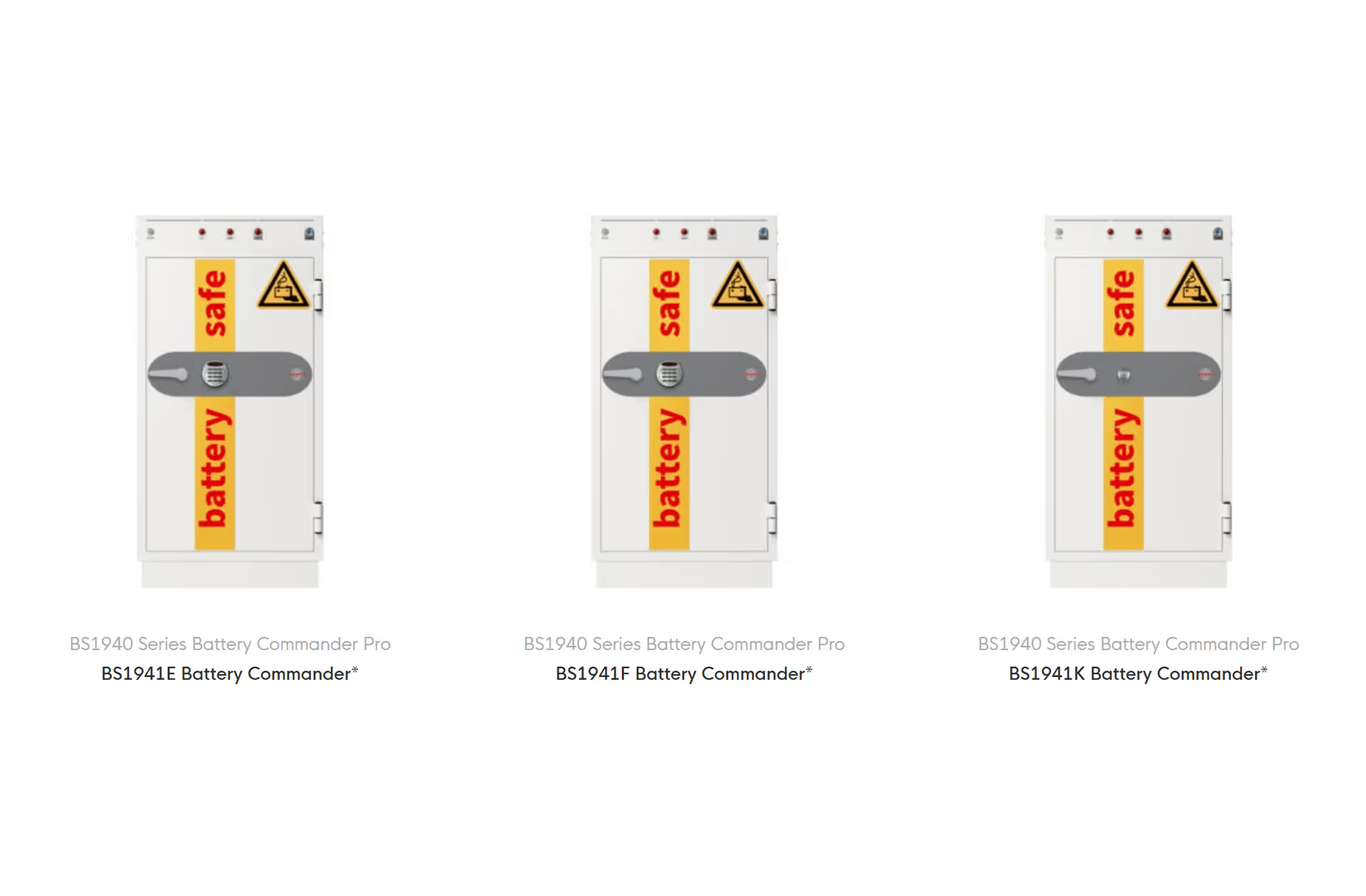
Battery Commander Pro BS1940
Certified protection when Lithium‑Ion batteries become a critical fire threat.
The BS1940 Series is independently certified to VDMA 24994:2024‑08 by ECB•S, delivering one of the highest levels of assurance available for Lithium‑Ion battery storage and charging safety. These units are engineered to protect bothlife and property from the potentially catastrophic consequences of Lithium battery fires.
Lithium‑Ion batteries can fail violently — through temperature fluctuations, impact damage, or hidden manufacturing defects. Any of these cantrigger thermal runaway, leading to sudden ignition, explosive fire development, and an event that is notoriously difficult to control or extinguish.
The BS1940 Series is built to stop that scenario in its tracks. It provides a secure, certified, high‑performance environment that contains the danger, limits escalation, and keeps your business protected when the unexpected happens.
When the risk is extreme, only proven protection will do. The BS1940 Series delivers exactly that.
FirePro UK ships worldwide.
Available Sizes & Configurations
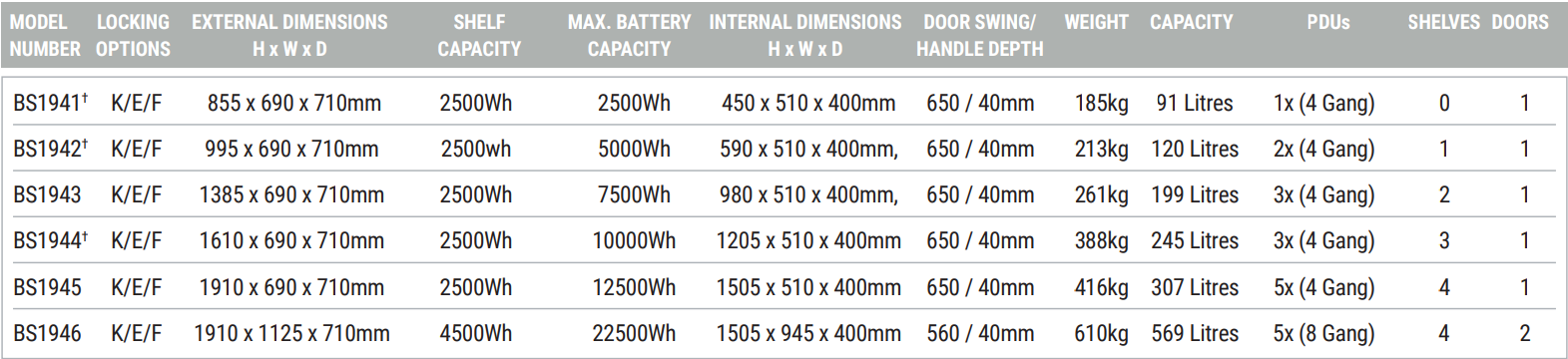
Each unit is available in a range of sizes and configurations to suit different storage capacities and operational requirements.
BS1941
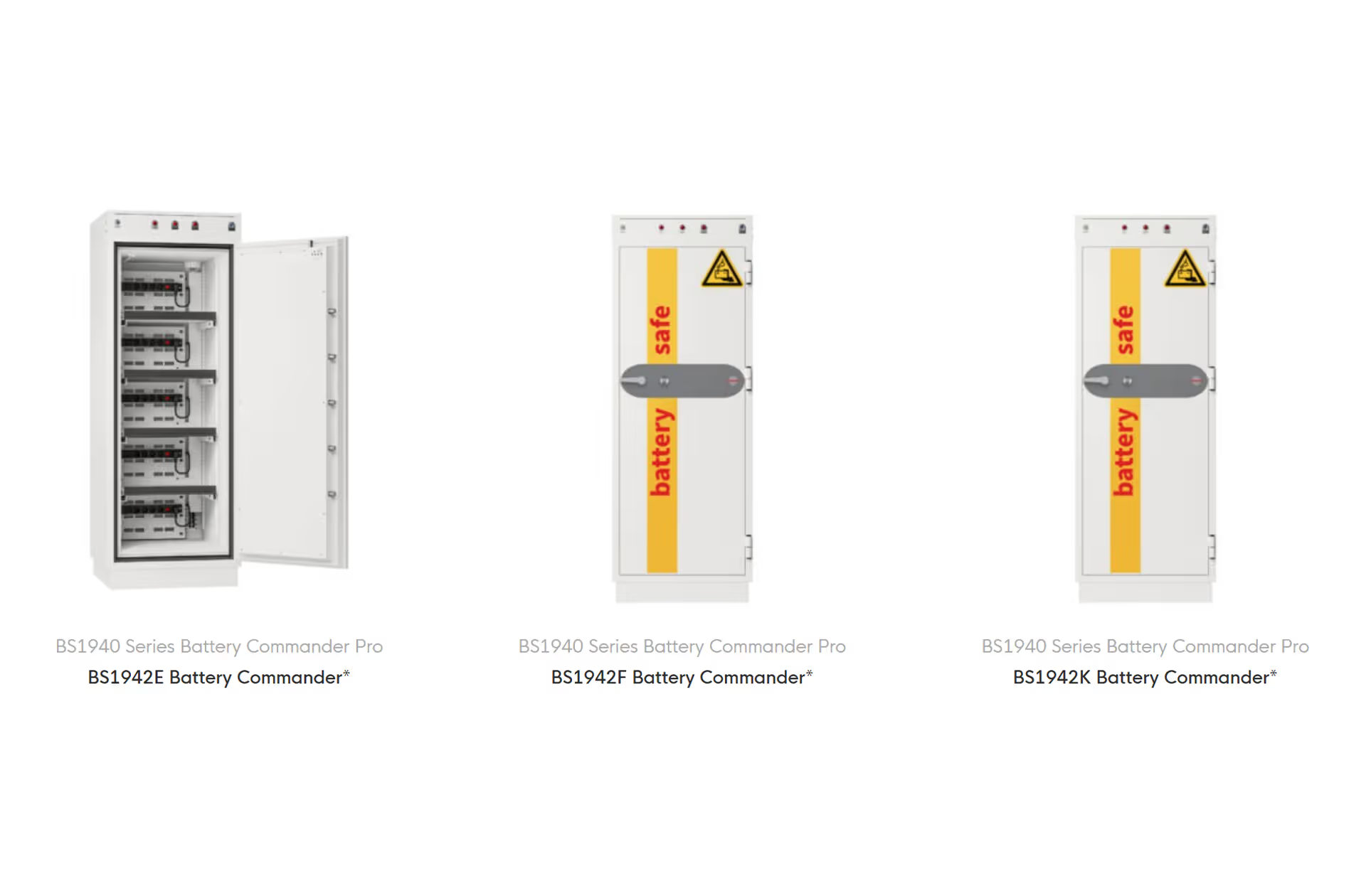
BS1942
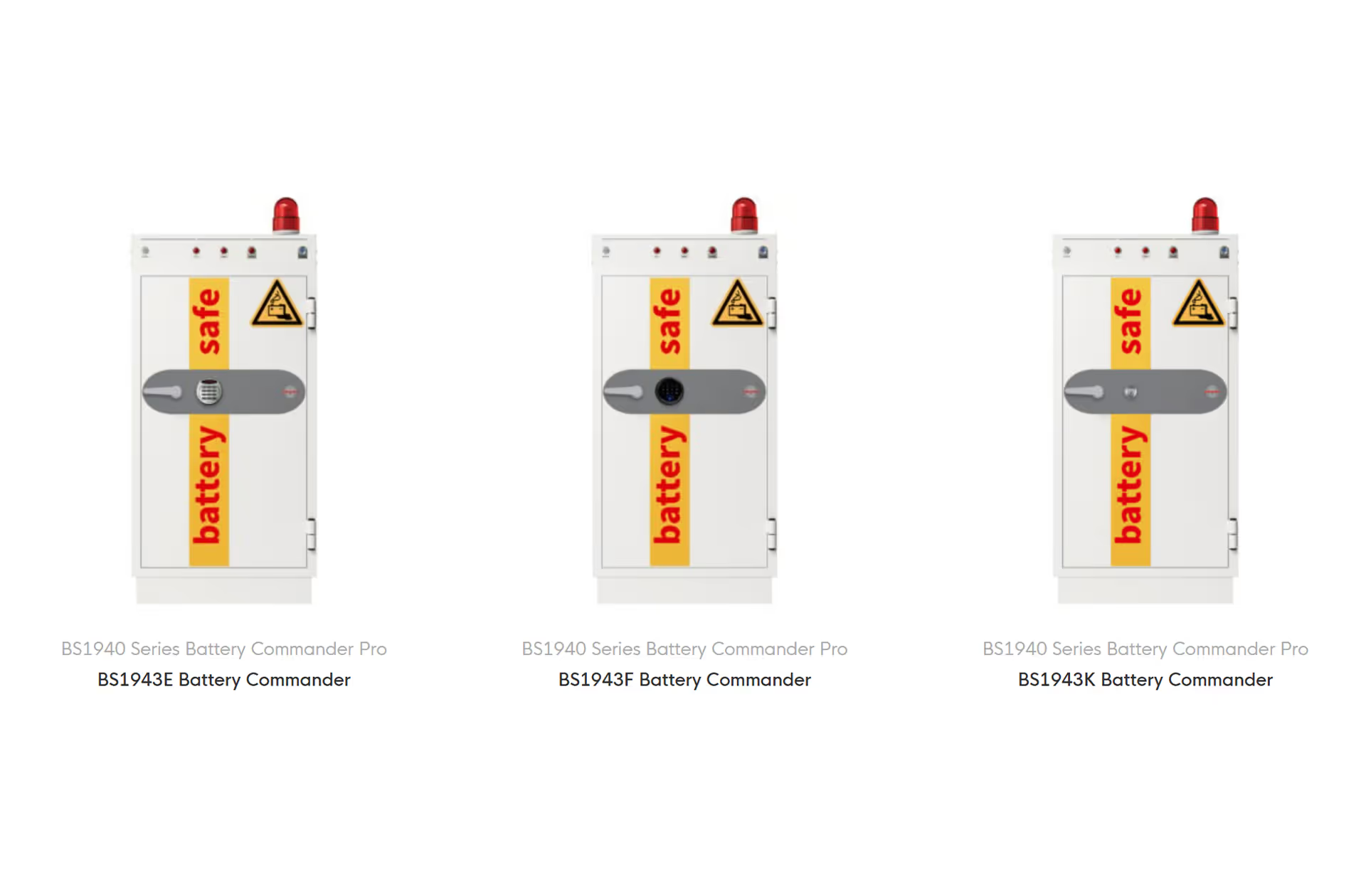
BS1943
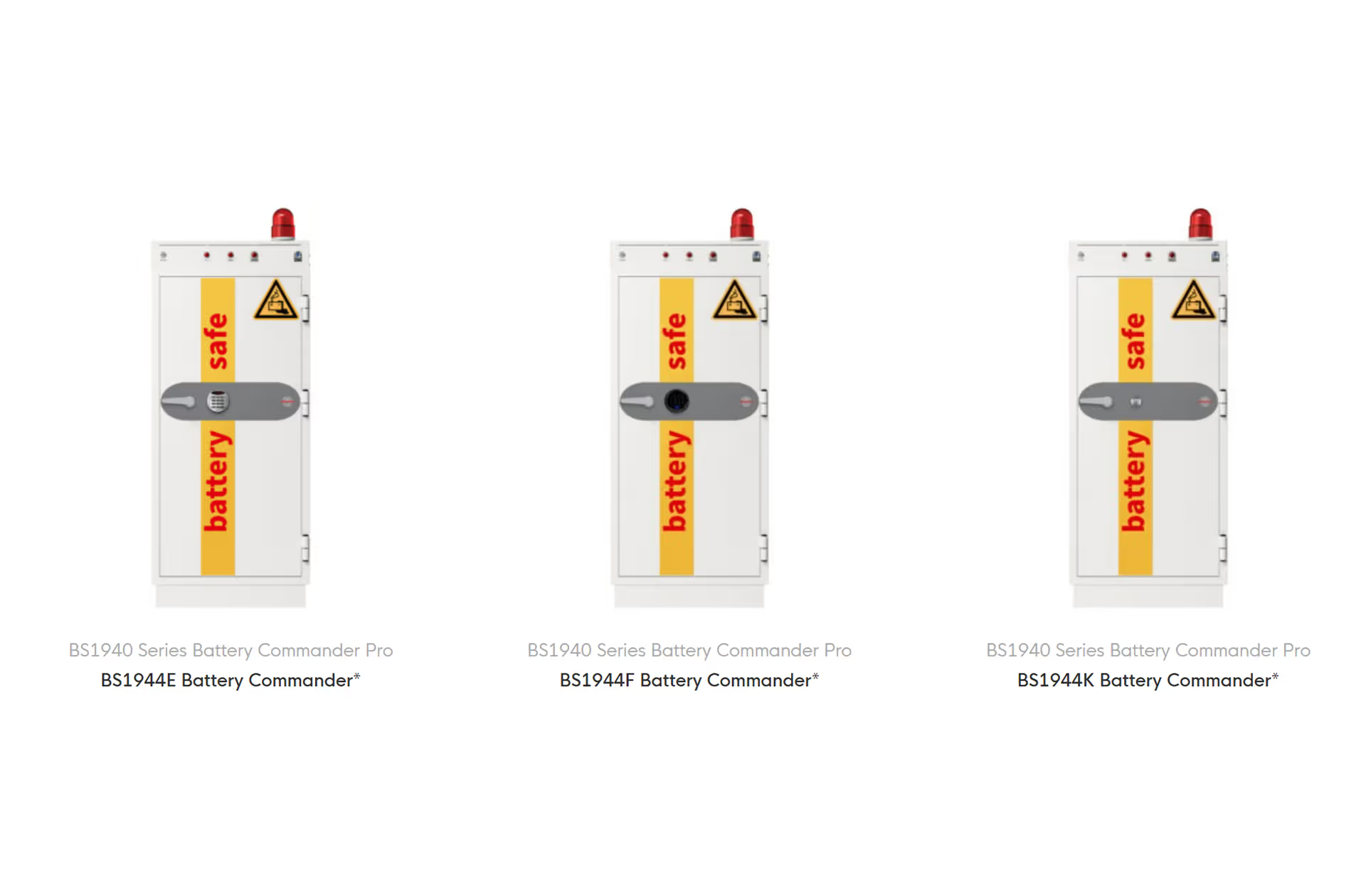
BS1944
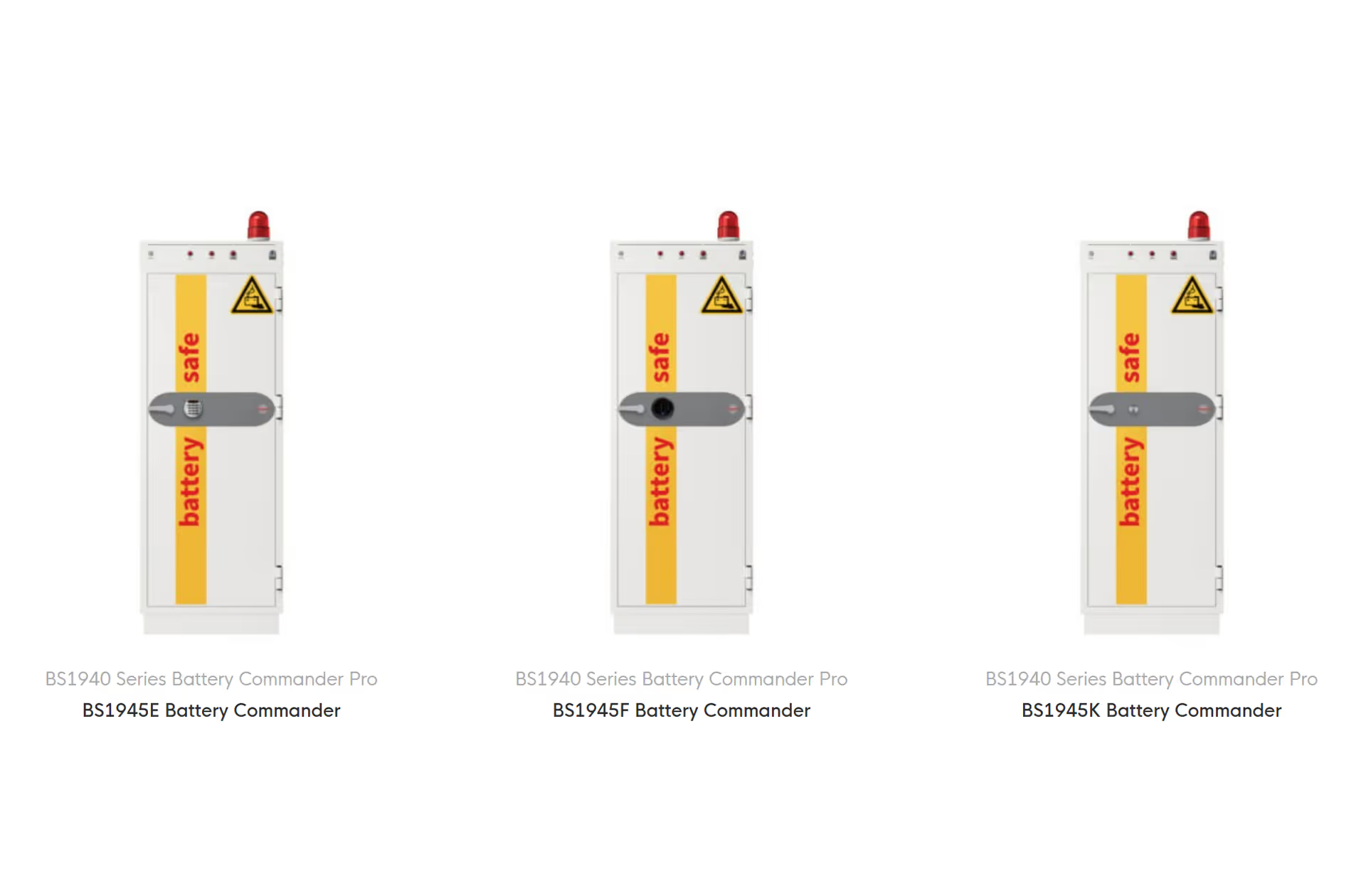
BS1945
BS1946

The number of batteries you can charge depends primarily on their individual size, wattage, and charging characteristics. Each FirePro fire safe provides up to 3000W or 13A per circuit, which is the governing limit for simultaneous charging.
Because Lithium‑Ion batteries draw power inconsistently — with peaks and fluctuations during the charging cycle — the exact load cannot be calculated from nameplate values alone. For accuracy, we recommend using a peak‑load (inrush) meter to determine the true maximum draw of your combined chargers.
In short, If the total real‑time load stays within 3000W / 13A per circuit, the safe can support it. A peak‑flow measurement confirms this with certainty and ensures full compliance and safe operation.
If your charging demand increases, you have three routes:
1. Add additional charging circuits FirePro UK safes can be configured with multiple independent charging circuits, allowing you to safely increase total available load. This is the most efficient way to scale capacity, particularly in non‑certified units where circuit expansion is more flexible.
2. Upgrade to a 3‑phase supply. For higher‑density charging environments, moving to a 3‑phase input provides significantly greater electrical headroom and supports larger charging arrays without overloading single‑phase circuits. This is the preferred option for commercial sites with continuous or high‑volume charging requirements.
3. Purchase a suitably sized fire safe with a 50% spare capacity to accommodate future expansion plans.I
n short: As your battery fleet grows, your FirePro system can grow with it — either by adding more circuits or stepping up to 3‑phase power for maximum capacity and operational resilience.
Yes. The safe can be continuously monitored. FirePro UK supply the Easthouse Safe Monitor, as a configurable add on which provides real‑time status visibility, environmental condition tracking, and early‑warning alerts. This allows you to integrate the safe into your wider safety management system, ensuring proactive oversight of temperature, power, and operational health
.In short: With FirePro UK & Easthouse monitoring, you always know the safe is performing exactly as it should — even before an issue develops.
No. The cabinet operates as an independent safety system and does not form part of the FirePro system.
Certified storage capacities are validated through formal testing and expressed in Wh or kWh.
For non-certified configurations, capacities are indicative only and should be treated as estimated guidelines. Always factor in physical battery dimensions, internal volume constraints and shelf load ratings and structural limits.
Certified cabinets are tested with suppression systems installed but inactive; performance certification is achieved without reliance on suppression.
Key testing criteria include mandatory ignition of all batteries within the cabinet and capacity ratings exclude any batteries that fail to ignite during testing.
While not required for compliance, suppression systems can mitigate the intensity of thermal events, reduce propagation between cells and potentially prevent secondary ignition.Note: suppression hardware occupies usable storage volume.
Integration is only possible when a compatible control system is installed within the cabinet.
Three control system variants have been deployed to date, however compatibility should be confirmed case-by-case.
Yes. Additional ventilation connections can be incorporated at the cabinet base in full compliance with certification requirements, enabling integration with forced or filtered airflow systems.
Connect with FirePro UK: Your Gateway to Enhanced Fire Safety
Feel secure in your fire protection solutions – connect with FirePro UK today for innovative and reliable fire suppression technologies.